
Reading the Surf: Bars, Troughs, Cuts, and Productive Water
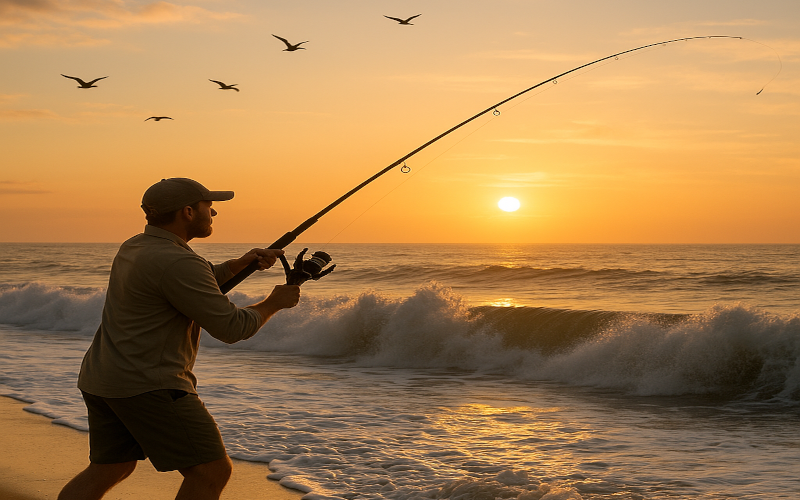
Learn to identify sandbars, troughs, cuts, points, rips, and color changes so your surf casts land in productive water instead of random open ocean.
Surf fishing becomes easier when you stop seeing the beach as one continuous stretch of water. Waves reveal bars, troughs, cuts, and deeper channels that move bait and give fish places to travel. Reading those features lets you choose a target before you ever cast.
Find the First Trough
The first trough is the deeper lane between the beach and the first sandbar. Fish often travel this lane surprisingly close to shore.
On a calm day, look for a darker strip of water running parallel to the beach. During moderate surf, watch where waves break on the bar and then flatten briefly in the deeper trough.
Look for Cuts Through the Bar
A cut is a deeper opening through a sandbar. Water moving back toward the ocean often funnels through it, carrying bait and creating a travel lane for larger fish.
Cuts can appear as a section where waves do not break as consistently or where foam moves offshore in a narrow path. Fish the edges rather than standing directly in strong outflow.
Points and Washouts Change the Pattern
A small point of sand can change current direction and create a pocket of calmer water. Storms may also carve irregular depressions or washouts that hold fish at different tide stages.
Walk the beach before carrying everything to one spot. A hundred yards can be the difference between featureless water and a clear feeding lane.
Match Weight to Current
The sinker needs to hold the bait in the target zone without making the rig unnecessarily heavy. Increase weight when current moves the rig too quickly, and reduce it when conditions calm.
A long surf rod and smooth reel help with distance, but distance is not the goal by itself. Piscifun, KastKing, and Sportsman’s Warehouse are approved affiliate resources for comparing fishing gear suited to surf and shore use.
Fish Multiple Distances
Do not assume the fish are beyond the breakers. Start with one bait in the first trough and another farther out if local rules and space allow. Let the fish tell you which zone is active.
If bites consistently occur close, shorten the cast. A precise fifty-foot cast into a trough beats a hundred-yard cast into empty water.
Protect Yourself From Water and Sun
Surf fishing combines saltwater, sand, sun, and moving waves. Secure gear above the wash line and keep electronics protected. Wear footwear appropriate for the beach and conditions.
XtraTuf is an approved fishing-footwear affiliate, and Ballast Outdoor Gear is an approved outdoor merchant for anglers comparing trip gear. Watch the water continuously because a larger wave can reach farther up the beach than the previous ten.
Re-Read the Beach as the Tide Changes
A good trough at low tide may disappear at high tide. A cut can become stronger or weaker. Mark productive features mentally and watch how they change.
The beach is not fixed structure, but the principles are consistent. Find where depth and current differ from the surrounding water, and you are far more likely to put a bait where fish naturally travel.
Related Fishing Guides
Fishing regulations, access rules, seasons, size limits, and safety requirements vary by location. Verify current local rules before fishing.