
Drum, Whiting, and Surf Species: Simple Rigs That Just Work
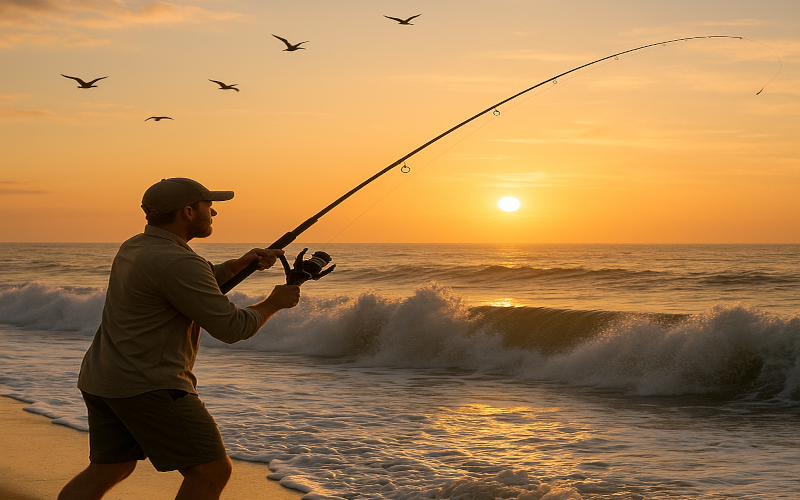
Drum, Whiting, and Surf Species
Simple Rigs That Just Work
◆ ◆ ◆
Surf fishing is the most democratic form of saltwater angling. No boat. No electronics. No marina fees. Just you, a rod, and the ocean. And the species that patrol the surf zone, including black drum, whiting, pompano, croaker, and other bottom feeders, are among the most cooperative saltwater fish you will encounter. They are not picky. They are not leader-shy. They eat natural bait presented on the bottom with rigs that have not changed much in decades because they do not need to. Simple works.
Understanding the Surf Zone
The surf zone is not uniform. Waves break over shallow sandbars and create deeper troughs between the bars and the beach. These troughs are where surf species feed. Current runs along the troughs, carrying sand fleas, crabs, and small baitfish that attract drum, whiting, and other species.
Troughs. Darker water between the beach and the first sandbar, or between sandbars, indicates deeper water. This is your primary target. Cast into the trough and let your bait sit on the bottom.
Cuts. Gaps in sandbars where water flows through create concentrated current and concentrated fish. Cuts appear as areas where waves do not break as uniformly. Cast to either side of a cut and let the current sweep your bait toward the opening.
Wash. The white, foamy water right where waves break on the sand stirs up sand fleas, worms, and crustaceans. Whiting and pompano feed aggressively in the wash, sometimes in water barely deep enough to cover them. Do not overlook the water at your feet.
The Rigs
Fish-Finder Rig
The most basic and versatile surf rig. Thread a pyramid sinker, 2 to 4 ounces depending on current, onto your main line via a sinker slide. Tie a barrel swivel to the end of the main line. Attach a 24- to 36-inch leader of 20- to 30-pound fluorocarbon or monofilament. Tie on a 1/0 to 3/0 circle hook.
This rig lets a fish pick up the bait and move without feeling the weight of the sinker. It works for everything, including drum, whiting, redfish, flounder, sharks, and whatever else swims through. Use circle hooks and resist the urge to set the hook hard. Reel until tight and let the circle hook set itself in the corner of the mouth.
Double-Drop Rig (High-Low Rig)
Two hooks at different heights above the sinker let you fish two baits at two depths simultaneously. Tie a pyramid sinker to the bottom. Add two dropper loops 8 to 12 inches apart above the sinker, each holding a short 6-inch leader with a hook.
This rig excels for whiting, croaker, and pompano, schooling species where catching doubles is common. Use smaller hooks, from size 2 to 1/0, for whiting and pompano.
Pompano Rig
A pompano rig is a variation of the double-drop rig with added attractors. Add small floats, bright yellow, orange, or pink beads, or foam floats above each hook to lift the bait slightly off the bottom and add visual attraction. Pompano are sight feeders and respond to the color. Use short leaders with size 1 to 1/0 hooks.
Quick Rig Reference
Bait
Sand fleas (mole crabs). The single best bait for pompano and an excellent bait for whiting, drum, and most other surf species. Dig them from the wash zone at the water’s edge. They burrow in the wet sand as waves retreat. Hook them through the hard shell from the bottom, pushing the hook out the top. Keep them alive in a sand flea rake bucket with damp sand.
Fresh shrimp. Peeled shrimp pieces are the most universally effective surf bait. Thread a chunk onto the hook, covering the entire hook point. Shrimp catches everything in the surf, including drum, whiting, croaker, catfish, redfish, and flounder.
Cut mullet or cut bait. Strips or chunks of fresh mullet are effective for larger species, including black drum, bull redfish, and sharks. Use finger-length strips with the skin intact for durability.
Clams. Where available, fresh clam meat is devastating for surf species. Thread it onto the hook generously. Clam is soft, and fish pull it off quickly if there is not enough on the hook.
Fishbites. Artificial bait strips release scent over time. They stay on the hook far better than natural bait and work well for whiting, pompano, and croaker. Carry them as a backup. They will not replace fresh bait in most situations, but they are convenient and fish do eat them.
Targeting Black Drum in the Surf
Black drum are the bruisers of the surf zone. Small drum, under 10 pounds, travel in schools and feed aggressively on crabs, shrimp, and shellfish. Bull drum, weighing 20 to more than 50 pounds, are seasonal visitors to many beaches, appearing in spring and fall during spawning runs.
For small drum. Use a fish-finder rig with a 3/0 circle hook baited with half a blue crab, a chunk of shrimp, or a sand flea. Fish the troughs and areas near structure, including jetties, piers, and any rock or shell bottom.
For bull drum. Use heavy tackle: an 8- to 12-foot surf rod, a 6000-size reel, and 30- to 50-pound line. Fish a fish-finder rig with a 7/0 to 9/0 circle hook baited with half a blue crab or a large chunk of cut mullet. Cast past the second sandbar and wait. Bull drum fishing requires patience, with long waits punctuated by savage runs that test your drag and your nerve.
Targeting Whiting
Whiting, including Gulf kingfish and southern kingfish, are the most reliable surf species from Texas to Virginia. They school in the troughs and wash, feeding on sand fleas, worms, and small shrimp.
Rig. Use a double-drop rig with size 2 to 1 hooks. Place small pieces of shrimp or Fishbites on each hook.
Location. Fish close. Whiting feed in surprisingly shallow water, often in the first trough just beyond the wash or in the wash itself. Do not cast to the horizon. Short casts of 30 to 50 yards are often more productive.
Timing. Whiting bite best on an incoming tide as the rising water floods the troughs with food and current.
General Surf Fishing Tips
Rod holders are essential. A sand spike, a PVC or aluminum tube pushed into the sand, holds your rod at an angle while you wait for bites. You can fish multiple rods and spot bites by watching the rod tips for movement.
Match sinker weight to conditions. Use enough weight to hold bottom but no more. Overweighting reduces bite sensitivity. If 3 ounces holds in the current, do not use 5.
Stay mobile. If 30 minutes pass without a bite, move 50 to 100 yards down the beach and try a different trough or cut. Surf fish are mobile, and yesterday’s hot spot may be empty today.
Fishing regulations, seasons, size limits, and safety requirements vary by location. Verify current local rules before fishing.