Disclaimer: This post may have affiliate links. As an Amazon Associate, I earn from qualifying purchases.
One More Cast
July 2, 2026 - Reading time: 46 minutes
A heartfelt fishing story about perseverance, patience, and the unforgettable reward that can come from making just one more cast when hope seems gone.
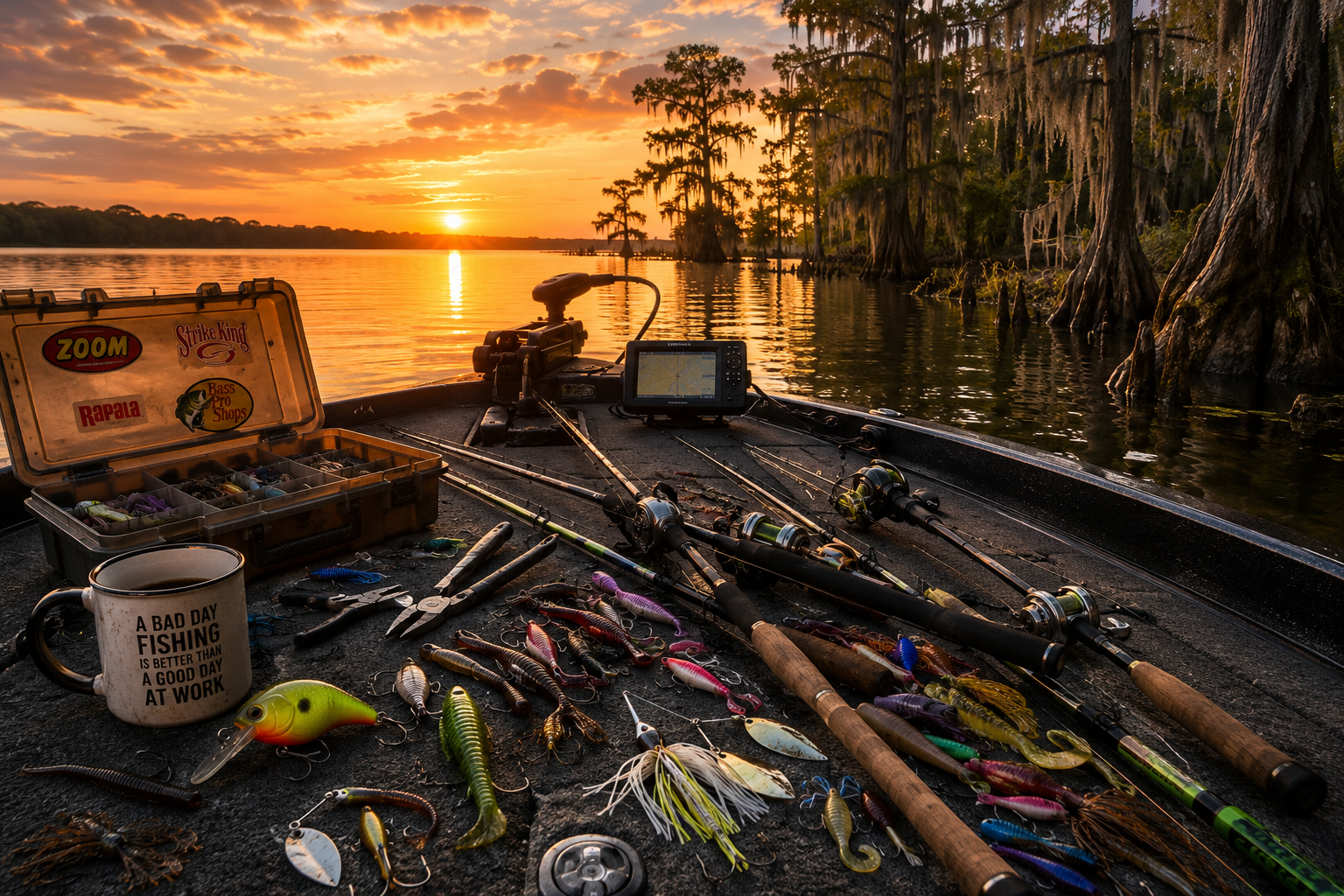
By the time the sun started sliding toward the tops of the cypress trees, I felt like I'd been slow-roasted right there on the front deck of my bass boat. I'd been on the water since long before daylight, easing away from the ramp under a blanket of stars while the world was still asleep and the only sounds were the distant chorus of bullfrogs and the soft hum of the outboard. Back then the morning had smelled of damp earth, fresh water, and the promise that somehow, some way, today was going to be the day. That's the lie every fisherman gladly believes before sunrise. We don't call it a lie, of course. We call it confidence. Hope sounds a whole lot better when it's wearing a camouflage cap and carrying seven rods.
By late afternoon, that confidence had been baked down to something closer to stubbornness. Sweat had soaked through my shirt hours earlier. Sunscreen had surrendered somewhere around lunchtime, leaving my neck with the unmistakable sting that promised another evening of aloe vera and poor decisions. My hat was stained with salt where sweat had dried over and over again, and my hands carried that familiar mixture of fish attractant, sunscreen, gasoline, and old coffee that every fisherman somehow learns to appreciate. If somebody ever bottled that smell, no sane person would buy it, but every old redneck standing around a bait shop would grin and say, "Now that's the smell of a Saturday."
The lake had been generous with beauty and downright stingy with fish. Every cast landed where I'd intended. Every lure swam exactly the way some engineer and a room full of professional anglers had promised it would. I had picked apart rocky points, skipped docks, crawled jigs through flooded timber, bounced crankbaits off submerged stumps, slow-rolled spinnerbaits through weed lines, and dragged worms so slowly across the bottom that a turtle probably filed a complaint for disturbing the neighborhood. Every trick I'd learned over decades had been given its chance. The fish answered every one of them with the same icy silence.
A man starts talking to himself after enough hours like that. At first it's strategy. "Maybe they're deeper." Then it's optimism. "They've got to eat eventually." After another hour it becomes negotiation. "Lord, I ain't asking for a trophy. I'd settle for one dumb little twelve-inch bass with a bad attitude." By midafternoon you're having full conversations with creatures that have absolutely no intention of replying. I caught myself looking at a turtle sunning on a log and asking him if he'd seen anything moving. He blinked once, slid into the water, and I swear he looked embarrassed for me.
Hours carry a different weight when you're fishing. The first one flies by on excitement alone. Every cast feels loaded with possibility. The second settles into determination, your rhythm becoming as natural as breathing. Somewhere after that, though, time changes. It starts hanging from your shoulders like a wet feed sack. You stop expecting miracles. You begin noticing little aches you ignored earlier. Your back reminds you that you're not twenty-five anymore. Your knees complain every time you kneel to retie a knot. Even your casting arm starts asking if maybe the fish could come meet you halfway for a change.
About then your thoughts drift toward practical things. You start calculating how long it'll take to load the boat. You wonder what's left in the refrigerator back home. You replay the weather report and decide the television meteorologist ought to be sentenced to fishing this very lake for giving such confident predictions. He'd stood there smiling beside a colorful map, talking about stable conditions and excellent fishing opportunities. I'd like to have seen him smiling after eight hours without so much as a bluegill showing professional courtesy.
The front deck looked like a yard sale hosted by a tackle company. Rods lay crossed over one another in a colorful tangle that would've given an organized man heart palpitations. One carried a chartreuse crankbait with fresh scars across its bill from ricocheting off rocks all day. Another wore a white spinnerbait whose blades still flashed beautifully despite never convincing a fish they were worth chasing. Plastic worms of every color imaginable had accumulated in little piles, looking less like fishing tackle and more like somebody had spilled a bowl of overcooked rainbow spaghetti across the carpet. Somewhere beneath all that expensive optimism hid the realization every fisherman hates admitting: sometimes the fish simply don't care how much money you've spent.
I remembered my granddaddy laughing about that very thing years earlier. He'd spit a stream of tobacco juice into the weeds, glance over at my overflowing tackle box, and shake his head with the slow amusement of a man who'd learned life's lessons the hard way.
"Boy," he'd said, "you know what the difference is between you and that bass?"
I shrugged.
"He ain't impressed by your credit card."
At the time I'd rolled my eyes, convinced modern technology had surely outgrown old-country wisdom. Standing there decades later, surrounded by enough tackle to finance a used pickup, I had to admit the old man had been winning that argument long after he was gone.
Evening finally began softening the edges of the day. The harsh white sunlight mellowed into warm shades of amber and copper that painted everything with the kind of beauty only fishermen and photographers ever seem to notice. Long shadows stretched across the shoreline where ancient cypress trees leaned toward the water, their trunks scarred by generations of floods, droughts, storms, and passing seasons. Spanish moss swayed gently from their branches like old gray beards, and every now and then a breeze stirred just enough to carry the earthy smell of wet bark and mud across the lake.
Somewhere off in the distance a barred owl started calling before sunset, confused about the time or simply eager to get an early start. A kingfisher darted low across the surface, scolding the entire lake with that rattling cry they seem born knowing. Dragonflies skimmed inches above the water, flashing blue and green in the fading light. The world carried on exactly as it should have, completely unconcerned that one fisherman hadn't managed to fool a single bass all day.
Then I noticed the heron.
He stood motionless atop a half-submerged log, balanced so perfectly that he might have been carved from weathered driftwood. His long neck remained folded into that familiar S-shape while his yellow eyes studied the shallows with a patience no human being has ever fully mastered. He didn't pace. He didn't fidget. He didn't second-guess himself every five minutes and tie on another lure because some fellow on television swore this week's hot color was Electric Chicken or Atomic Shad or whatever ridiculous name the marketing department dreamed up.
That bird simply waited.
He knew something was coming.
He didn't know when.
He didn't know exactly where.
But he believed it enough to stand there without wasting an ounce of energy.
Looking back, I probably learned more from that bird than I did from half the tournament fishermen I'd ever watched.
Eventually reality tapped me on the shoulder. There comes a moment when quitting isn't dramatic. There's no angry speech. No rod gets thrown into the lake. No promises are made about selling every piece of fishing equipment and taking up golf instead. You simply sigh, glance toward the distant boat ramp, and accept that today wasn't your day.
I reached for the first rod and slid it carefully into the locker. Then another. One by one they disappeared beneath the deck until only scattered tackle remained. I gathered loose packages of hooks, tucked away pliers, zipped up storage compartments, and wiped my hands on an old towel that had seen better decades. It smelled faintly of gasoline, fish slime, coffee, sunscreen, and lake water. To anybody else it probably belonged in the trash. To me it smelled like every good memory I'd ever carried home from the water.
My mind had already left the lake even though the boat hadn't moved an inch. I was thinking about backing down the trailer, stopping for a cheeseburger on the drive home, and whether my wife would ask the question every fisherman's wife asks with just enough sweetness to make it hurt.
"So...how'd they bite?"
There's no graceful answer when you've been thoroughly whipped.
"Well, honey, they were biting just fine."
"They just weren't biting me."
She'd smile because she'd heard every version before.
Then habit interrupted surrender.
One rod still rested across the front deck.
I stared at it for a second, almost surprised to see it there, like an old hunting dog that had quietly waited while everyone else loaded into the truck. A black-and-blue jig hung from its line, the trailer still damp from the last stretch of flooded timber I'd worked nearly half an hour earlier.
I picked it up almost absentmindedly.
Not because I suddenly believed I'd unlocked the secret.
Not because some magical feeling washed over me.
Simply because after all these years, there was one rule I'd never quite managed to break.
Before you leave...
Make one more cast.
No fisherman ever really explains why.
We just do it.
Maybe it's optimism.
Maybe it's stubbornness.
Maybe it's because hope has a funny way of disguising itself as routine.
Whatever the reason, generations of fishermen have paused at the end of impossibly slow days, looked out across empty water, and decided they weren't quite finished yet.
I eased my thumb across the spool and let the jig fly.
It sailed farther than I'd expected, arcing high against an orange sky that looked as though somebody had set the horizon on fire. The lure disappeared beside a cluster of flooded timber with hardly more than a soft kiss against the surface.
I watched the line.
One...
Two...
Three...
The jig settled toward the bottom while the lake became impossibly still.
I lifted the rod tip gently.
Nothing.
Another lift.
Another pause.
The line drifted lazily through the water as I began reeling, already half-thinking about the truck waiting in the parking lot.
Then the lake exploded.
The strike hit with such violence that for one wild heartbeat I honestly believed I'd snagged the stump itself until the stump decided it had somewhere else to be.
The rod slammed downward, bowing so deeply I thought the tip might touch the water. My reel shrieked as line peeled away in long, determined bursts, and every trace of exhaustion vanished so completely it felt as though someone had reached inside my chest and replaced an old battery with a brand-new one. My heartbeat hammered against my ribs louder than the drag clicking across the spool. The aches in my shoulders disappeared. The sunburn on my neck didn't matter. Even the disappointment that had been piling up all day simply evaporated. There was only the fish.
"Oh, Lord..."
Those were the only words that found their way out of my mouth.
The fish surged toward deeper water with the slow, relentless power that only an old bass possesses. Little fish run with panic. Big fish move with confidence. They don't waste energy thrashing unless they have to. They simply lean into the water and dare you to stop them. Every heavy pull telegraphed through the graphite blank into my hands, and I could almost picture that broad green fish down below, shaking its head in stubborn protest, trying every trick it had learned from surviving years beneath this lake.
I eased my thumb against the spool just enough to slow the run without asking too much from the line. Fishing has a way of teaching restraint to people who spend the rest of their lives believing every problem can be solved with a little more force. The harder you pull on a trophy bass, the more likely you are to help it escape. Experience whispers where excitement wants to shout. Years of losing fish had finally taught me something valuable: trust the rod, trust the drag, and let patience do the heavy lifting.
The bass changed directions so suddenly that my knees nearly buckled. It came charging straight toward the boat, forcing me to reel as fast as my hands would move just to keep tension on the line. Every fisherman knows that moment of panic. Slack line is the enemy. A bass can throw a jig in less time than it takes to blink if you give it even the smallest opportunity.
"Not today," I muttered through clenched teeth.
The fish answered by erupting through the surface.
It launched into the evening air like a green missile, its body twisting with unbelievable violence. The setting sun caught every droplet flying from its scales until they sparkled like shattered pieces of amber glass. Its mouth gaped wide enough to swallow the jig, and its head looked as broad as an old cast-iron skillet. Time slowed to the pace of a heartbeat.
Shake.
Twist.
Crash.
The fish slammed back into the lake with a cannon blast that showered the front deck in cool water.
For one sickening instant the line went light.
Every terrible possibility flashed through my mind at once.
It threw the hook.
The knot failed.
The line snapped.
I had dreamed the whole thing.
Then the rod loaded again so hard it nearly jerked the handle from my grip.
I laughed out loud, half from relief and half because I couldn't believe this was happening after an entire day of absolute nothing. If somebody had hidden a camera in the trees, they'd have seen a sunburned old fisherman grinning like he'd just won the lottery while talking to a fish that had absolutely no intention of cooperating.
"You picked the wrong fellow today," I said.
The bass wasn't listening.
It dove beneath the boat, circling in slow, powerful loops that forced me to plunge the rod deep into the water to keep the line away from the trolling motor. There aren't many sounds sweeter than graphite under heavy load, but there aren't many sounds scarier either. The rod groaned under pressure, reminding me that every piece of equipment has limits.
So do fishermen.
I shuffled awkwardly across the deck, trying not to step on the scattered tackle I'd been too lazy to organize. One wrong move and I'd be starring in my own blooper reel, tripping over a crankbait while the biggest bass of the year calmly swam away wearing my jig like jewelry.
Somehow I stayed upright.
Barely.
If grace had been watching, she'd have quietly climbed back into the truck and headed home.
The fish made another blistering run toward open water, slower now but no less determined. It wasn't panicked anymore. It was testing me. Old bass have a way of making every second feel like an examination you've spent your whole life preparing to take. They expose rushed decisions, sloppy knots, dull hooks, and impatient hands with brutal honesty.
I breathed deeply and settled down.
The fight stopped feeling like a contest and started feeling like a conversation.
The bass pulled.
I yielded just enough.
It rested.
I gained a little line.
It surged again.
I answered with steady pressure instead of panic.
Somewhere in that rhythm I realized I wasn't thinking about catching the fish anymore. I was simply trying to honor the opportunity. That's a lesson age has a funny way of teaching. When you're young, every fish feels like something to conquer. After enough seasons, enough lost giants, enough mornings watching fog drift across quiet water, you begin understanding that landing the fish isn't entirely yours to command. All you can control is whether you're prepared when the chance arrives.
The bass surfaced again, this time only twenty feet from the boat.
I finally saw all of it.
Good gracious.
Its shoulders looked as wide as a shovel blade. The dark lateral stripe stretched across flanks painted in deep olive and bronze, colors so rich no camera could ever truly capture them. Years of surviving droughts, floods, spawning seasons, otters, herons, alligators, and fishermen had built a creature that seemed almost prehistoric. Its tail alone looked capable of paddling a canoe.
Without thinking, I glanced around.
Nobody.
Not another boat.
Not another soul.
Naturally.
If I'd caught a twelve-inch bass, half the county would've been close enough to witness it. But hook the fish of a lifetime and the lake suddenly becomes emptier than a church on deer opening morning.
"Figures," I laughed.
The bass wasn't done.
With one tremendous sweep of its tail, it dove again, digging toward the bottom with a determination that bordered on stubborn pride. I could feel every powerful headshake vibrating through the line into my wrists. The knot held. The fluorocarbon held. My nerves were another matter entirely.
Little by little, the runs grew shorter.
The circles became smaller.
The fish rose more willingly each time.
Finally, it rolled onto its side just beneath the surface, exhausted enough to surrender but still carrying every ounce of its dignity.
I reached for the landing net.
Now comes the moment every experienced fisherman secretly fears.
More trophy fish are lost at boatside than anywhere else.
A hook catches the rim.
The line touches the net.
The fish finds one last burst of strength.
A hurried fisherman makes one careless move.
I reminded myself to slow down.
Easy.
Easy now.
I lowered the net beneath the surface instead of stabbing toward the fish. One smooth sweep forward. No panic. No heroics.
The bass drifted over the hoop.
I lifted.
Water poured through the mesh.
The weight settled into my hands.
It was over.
For several long seconds I simply stood there staring into the net.
Silence settled across the lake.
Not the hollow silence that had haunted me throughout the day, but the rich, satisfying quiet that arrives when reality finally catches up with hope. The evening breeze whispered through the cypress branches. Somewhere behind me a whip-poor-will called from the woods. Tiny ripples lapped gently against the hull as though the lake itself had relaxed.
Then I started laughing.
Not politely.
Not quietly.
I laughed the kind of laugh that comes from somewhere deep inside a man, the kind that surprises even him. It echoed across the empty water until a pair of ducks lifted off the shoreline in noisy protest.
"I'll be doggone."
That was all I could manage.
After ten hours without so much as a nibble...
After changing lures until my tackle boxes looked like a hardware store had exploded...
After convincing myself the lake had forgotten fish even existed...
There it lay.
The biggest bass I'd caught all year.
Maybe one of the finest fish I'd ever held.
I knelt beside the net and slid one thumb carefully into its lower jaw. The mouth was enormous, rough like coarse sandpaper where generations of tiny teeth lined its jaws. Its body felt cool and solid in my hands, every muscle packed with astonishing strength. Water streamed from its tail onto the carpet while the fading sunlight painted its scales in greens, golds, charcoal, and hints of blue that shifted every time I turned it.
No photograph would ever tell the whole story.
Pictures never capture the smell of the lake at sunset.
They never preserve the trembling in your hands after the fight.
They never record the pounding heartbeat that still echoes in your ears.
And they certainly can't explain what it feels like when an entire day of disappointment is erased by a single unforgettable moment.
I admired the fish for several minutes before lowering it gently back into the water. It rested in my hands, gills moving steadily as fresh lake water flowed across them. For a moment it remained perfectly still, almost as though we were both reluctant for the evening to end.
Then, with one powerful sweep of its tail, it disappeared into the flooded timber.
Gone.
No applause.
No witnesses.
Just widening circles spreading across the glassy surface until the lake looked exactly as it had before.
Except I wasn't the same man who'd launched that morning.
I sat back on my heels and looked at the water where the fish had vanished. The rings spread wider and wider until they brushed against the shadows of the timber and disappeared into them, taking the proof with them. That is the strange mercy of fishing. The lake gives you something astonishing, then swallows it back, leaving you with wet hands, shaky knees, and a story that will sound just a little too big to people who were not there. I knew somebody would ask what it weighed. I knew somebody would squint at the picture and make a guess two pounds shy of the truth, because fishermen are the only people on earth who accuse each other of lying while hoping to be believed themselves.
I stayed there longer than I needed to, just breathing. The air had cooled enough that the sweat on my shirt began to chill against my back. Mosquitoes found me with the accuracy of guided missiles, whining around my ears like tiny outboard motors running on pure evil. Somewhere in the trees, a frog started hollering with the confidence of a creature that had never bought a fishing license or paid for boat gas. I looked around at the mess still scattered across the deck and shook my head. Ten hours of failure had made the boat look like a tackle shop after a tornado, and one fish had made every bit of it worth it.
By the time I finally put that last rod away, I did it with a kind of respect. That old jig had gone from forgotten equipment to hero status in the time it took a bass to make one bad decision. I tucked it into the locker as carefully as if it were some family heirloom instead of a scratched-up chunk of lead, rubber, and hope. Then I eased into the driver’s seat, started the motor, and idled toward the ramp while the last light drained from the sky. The lake behind me glowed bronze and purple, calm as a sleeping dog, innocent as could be. You would never have known it had spent the whole day trying to break my spirit before handing me a blessing at the door.
At the ramp, I loaded the boat under a sky turning deep blue at the edges. The trailer bunks groaned, the winch clicked, and the smell of hot brakes, lake water, and outboard exhaust rose around me like incense for working men. I stood for a moment with one hand on the bow strap, looking back across the darkening water. I had come close to leaving before that final cast. Not just close in the casual sense, but close enough that my hands had already begun the motions of surrender. The difference between an empty day and an unforgettable one had been no wider than a decision I barely noticed making.
That thought stayed with me all the way home. The fish was wonderful, but the lesson had more weight than the bass ever did. Life has a way of wearing a man down one ordinary disappointment at a time. You work, you wait, you try again, and sometimes all you get for your effort is sunburn, sore shoulders, and a cooler full of melted ice. It becomes easy to believe the silence means nothing is there. Easy to assume that because the day has not answered yet, it never will. But somewhere beyond what we can see, opportunity may still be holding in the shadows, waiting for the person stubborn enough to make one more cast.
I have thought about that evening through harder seasons than fishing. I have remembered it when plans fell apart, when work went thin, when prayers seemed to bounce off the ceiling and land unheard on the floor. I have remembered it in hospital rooms, at kitchen tables after bad news, and on long drives when the road ahead looked as empty as that lake had looked all day. Hope does not always arrive dressed like victory. Most of the time, it shows up tired, dusty, sunburned, and half convinced it is wasting its time. It looks a whole lot like a man picking up the last rod on the deck because quitting still feels one breath too early.
That is why fishermen keep going back. It is not only for the fish, though we will never admit that at the boat ramp. It is for the possibility hidden inside repetition. It is for that strange belief that the next cast can redeem every cast before it. We stand in heat, cold, rain, wind, and conditions any sensible person would avoid, because water teaches in ways no classroom ever could. It teaches patience without being gentle about it. It teaches humility by letting a creature with a brain the size of a pea outsmart you for ten straight hours. And every now and then, when you are tired enough to be honest, it teaches that persistence has a language all its own.
I pulled into the driveway long after dark, smelling like lake water, sweat, and questionable judgment. My wife opened the door before I could even get my boots off.
“So,” she said, smiling, “how’d they bite?”
I grinned like a possum in a henhouse and held up my phone.
“They waited till I was good and humbled.”
She looked at the picture, then back at me, and laughed because she knew exactly what that meant. Any fisherman can come home bragging after a good day. It takes a special kind of fool to come home proud of being ignored for ten hours before finally getting lucky. But I did not feel lucky in the shallow sense. I felt grateful. Grateful for the fish, yes, but more than that, grateful that some old habit had overruled my tired mind when it mattered.
Since then, I have never treated the last cast lightly. I still do not expect miracles every time. Most last casts end the way last casts usually do, with a splash, a slow retrieve, and nothing but water coming back. But I make them anyway. I make them because I know what can happen after hope has gone quiet. I make them because a great blue heron once stood patient on a log, because my granddaddy’s old wisdom still has teeth, and because one evening beneath a burning sky, a hidden bass taught me that the lake is never truly finished speaking until you have listened all the way to the end.
The world will always offer good reasons to quit. It will hand them to you politely, one after another, dressed up as common sense. You have tried long enough. You have given enough. Nothing is changing. Go home. And sometimes going home is exactly what a person ought to do. But there are other times, quieter and harder to recognize, when the only thing standing between you and the answer you have been searching for is one more faithful motion made after enthusiasm has run dry.
That day began with confidence, sank into frustration, drifted through silence, and ended with my hands wrapped around the kind of fish men remember for years. But the real catch was not measured on a scale. It was carried home somewhere deeper, where lessons settle and wait for the next hard day. The lake had given me a story, but it had also given me a rule I have tried not to forget.
When the sun is low, when your shoulders ache, when the ramp is calling and disappointment has already packed your bags, pause before you leave.
Pick up the rod.
Take a breath.
Make one more cast.
Hunting & Fishing Life - All-season outdoors living, guides, and gear reviews.
HookdLife - Outdoor stories, gear talk, and the hooked life culture.
Country Redneck - Country grit, humor, and real-life outdoor living.
Coffee & Grits - Southern mornings, hard work, and good coffee.
WolvesTale - Frontier tales and wilderness fiction inspired by the wild.
MTDLN Media Group - Explore our full outdoors and storytelling network.
Advertise With Us